AI Agent School by Peleg Dror

Build an AI-Powered Business
with Claude Code

The complete track for founding and running a business where every department has an AI employee - marketing, sales, customer service, HR and operations. Real business workflows, AI agents, and Vibe Coding. Without writing a single line of code.

Next cohort: August 12 - September 6, 2026  |  Wed & Sun, 18:00-22:00  |  Live on Zoom  |  ₪10,000 incl. VAT

8
Live Zoom Sessions
32
Hours of Training
4
Weeks
Save My Seat
The Program

Your Company. Staffed by AI.

AI is changing the way organizations and businesses work. This program trains you to found and run an AI-powered business with Claude Code - efficiently and affordably. Throughout the course you act as a founder-CEO: each session you "hire" one AI department, train it on your real business, and put it to work. By the end you present a fully wired AI company - and take it home with you. The structure is gradual and hands-on, with no prior knowledge or programming required.

Claude Code as a Business Workforce

Learn working methods that turn Claude Code into an efficient manager of departments, tasks and business processes.

Immediate Real-World Application

Every exercise in the course is based on real business processes - yours. You leave each session with assets your business can use the next morning.

Found an AI-Based Company

Plan, build and present a company powered by AI across all its departments: marketing, sales, HR and operations.

AI Agents for Business Work

Design and deploy AI agents that complete complex missions - with human control and management built in.

Vibe Coding Without Code

Build working tools and business solutions by describing them in plain language. No programming background needed.

Claude Projects for Knowledge

Build an organizational workspace that manages knowledge, documents and processes - so Claude answers like an insider.

The Curriculum

8 Sessions. 8 Modules.

Two four-hour sessions a week, for four weeks. One session = one module: a department hired, trained and put to work. Click any module to see exactly what happens inside.

Download the full syllabus (PDF)

S1 · 12/8 · 4h Founding Day & The Briefing Skill Found your AI company - and learn the delegation skill every department runs on.

We open with a founding ceremony: this course, you're a founder-CEO and Claude is your workforce. A live show of Claude doing real business work, then setup, then everyone founds their company on paper. From there we go straight to the core management skill: briefing. We dissect a great brief and a terrible one, then brief Claude on your company's first real tasks.

What Claude can actually do for a business - live demos

  • A customer complaint answered in brand voice, in 90 seconds
  • A price-list PDF interrogated with plain questions
  • A month of social posts generated from one idea
  • A working mini-tool built live by describing it - the 'wow' moment

Plans, setup, and the delegation mindset

  • Accounts and interface tour: chats, files, artifacts, research
  • The new-hire frame: brilliant and tireless, but knows nothing about you yet
  • The golden rule: Claude drafts every document, you make every decision
  • The org chart we'll build: HQ, front desk, marketing, HR, back office, tools, agents

Choosing your company for the course

  • Option 1: your real business - every exercise produces real assets
  • Option 2: a venture you've been meaning to found - the course is your incubator
  • Defining the basics: what you sell, to whom, what makes you different
  • Picking the 3 departments that would change your life first

Anatomy of a great brief: goal, context, format, tone

  • Goal: define 'done' in one sentence before typing
  • Context: audience, background, constraints, what's at stake
  • Format: email, table, one-pager, script - always say it
  • Tone: your company's voice in 3 adjectives + 1 example

Showing examples instead of explaining

  • Paste your best past email and say 'like this'
  • Before/after pairs: your raw draft vs. how you wish it sounded
  • Using competitor material as a 'not like this' example
  • One good example beats three paragraphs of instructions

Iterating: pushing back until the output is right

  • The manager's vocabulary: tighter, warmer, more concrete, less salesy
  • Asking Claude to critique its own draft first
  • 'Give me 3 versions' as a decision-making tool
  • Knowing when it's client-ready - the ship checklist
Hands-On Found your company: name it, define the departments Claude will staff - then brief Claude on its first real task and iterate until it's client-ready.
You Leave With A founded company with an org chart of future AI employees, plus the briefing checklist every session builds on.
S2 · 16/8 · 4h Company HQ: Onboarding Claude Teach Claude your business so it answers like an insider from week one.

Onboarding day for your new workforce. We build your company's knowledge base live: everyone assembles their HQ Project during the session, loads real company knowledge, and tests it with insider questions.

Claude Projects: what they are and why they change everything

  • A Project = a department office where Claude already knows the business
  • Standing knowledge vs. one-off chats: stop re-explaining yourself
  • What lives in a Project: files, instructions, ongoing conversations
  • The test: ask a question only an insider could answer

Uploading company knowledge: products, prices, policies

  • The knowledge inventory: what documents describe your business?
  • Products and services, price lists, policies, FAQs, key clients
  • The 'about us' brief: history, values, what makes you different
  • Keeping it current: the monthly knowledge refresh habit

Standing instructions: your brand voice and rules

  • Writing your voice guide: 3 adjectives, 2 example texts, 1 forbidden style
  • House rules: what Claude must always/never do for your company
  • Language, formality, sign-offs, terminology you insist on
  • Compliance basics: what never leaves the building

One Project per department: HQ, marketing, HR, sales

  • HQ holds the shared truth; departments hold their specialty
  • What marketing's office needs vs. what HR's office needs
  • Avoiding knowledge drift between departments
  • Naming conventions so your company stays navigable
Hands-On Build your company HQ Project plus one department Project, loaded with real knowledge.
You Leave With A working HQ that answers like an insider - the foundation every department is built on.
S3 · 19/8 · 4h The Front Desk: Customer Communication Every customer touchpoint, handled in your brand voice.

Your first department hire. We train the front desk on real scenarios from participants' businesses: complaints, quotes, FAQs - then stress-test it with the class playing difficult customers.

Complaint replies that keep the customer

  • The 4-part reply: acknowledge, own, resolve, invite back
  • De-escalation language: firm on facts, soft on people
  • When to compensate and when to hold the line
  • The reply you never send: handling abusive messages

Quotes and proposals from bullet points

  • From 5 bullets to a professional quote in your format
  • Options pricing: good/better/best in one document
  • The follow-up sequence for quotes that went quiet
  • Templates per client type: new, returning, VIP

An FAQ built from your real customer questions

  • Mining your inbox and chats for the questions that repeat
  • Writing answers once, in brand voice, at three lengths
  • The internal FAQ: answers your team gives consistently
  • Publishing: website, WhatsApp auto-text, printed one-pager

One message adapted for email, WhatsApp and a phone script

  • Same content, three registers: formal, chat, spoken
  • WhatsApp etiquette: short, warm, emoji policy per brand
  • The phone script with branching: if they say X, respond Y
  • Consistency check: does it still sound like one company?
Hands-On Answer 3 real customer scenarios from your business, in your brand voice.
You Leave With A staffed front desk: complaint playbook, quote template, FAQ v1, and a multi-channel voice.
S4 · 23/8 · 4h The Marketing Department One idea in, a month of content out.

Content factory day. We take one real idea from each participant's business and industrialize it: calendar, posts, campaign copy - plus a competitor-positioning session to sharpen the message.

Content calendar: from theme to schedule

  • Quarterly themes → monthly topics → weekly posts
  • The content mix: educate, entertain, sell - in what ratio
  • Batching: producing a month in one sitting
  • Realistic cadence: what you'll actually sustain

Social posts, campaigns and landing-page copy

  • Platform-native writing: LinkedIn vs. Instagram vs. Facebook
  • Hooks that stop the scroll: 10 formulas that work
  • Campaign anatomy: teaser, launch, proof, last-call
  • Landing page structure: promise, proof, price, push

Competitor research and positioning

  • Profiling 3 competitors: offer, price, message, weakness
  • The positioning sentence: for whom, what, unlike whom, why
  • Finding the gap: what nobody in your market is saying
  • Turning positioning into a tagline and an elevator pitch

Keeping one consistent voice across everything

  • The voice guide from HQ, now enforced in marketing
  • The consistency audit: 5 recent posts, one brand?
  • Voice drift: how it happens and how to catch it
  • Guest writers and freelancers: briefing them with your guide
Hands-On One idea → a month-long content calendar with the first week's posts ready to publish.
You Leave With A staffed marketing department: calendar, a week of publish-ready posts, and a positioning sentence.
S5 · 26/8 · 4h The HR Manager: Hiring & Managing Workers The people side of the business, prepared instead of improvised.

HR gets hired. We run a full hiring cycle on a real role from a participant's business - job description, rubric, CV screening, interview kit - then flip to managing: onboarding, 1-on-1s, and the hard conversations.

Job descriptions and screening rubrics

  • From 'we need someone' to a role definition: outcomes, not tasks
  • Job ads that attract the right people and filter the wrong ones
  • The screening rubric: 5 criteria, weighted, before you see a single CV
  • Must-have vs. nice-to-have - deciding in advance

CV screening and interview question sets

  • Screening a stack of CVs against your rubric in minutes
  • Red flags and green flags - and which are myths
  • Structured interview kits: same questions, comparable answers
  • Follow-up probes: getting past rehearsed answers

Onboarding plans for new hires

  • The 30-60-90 plan: what success looks like at each mark
  • Week-one checklist: access, intros, first small win
  • The onboarding doc pack, generated from your HQ knowledge
  • Assigning a buddy and structuring the check-ins

1-on-1s, performance reviews, and the hard conversations

  • The 1-on-1 agenda that isn't a status meeting
  • Writing balanced performance reviews from your rough notes
  • Preparing the hard conversation: script, objections, next steps
  • Practicing live: Claude plays the defensive employee
Hands-On Write a job description + screening rubric for a real role, then screen 3 sample CVs.
You Leave With A staffed HR department: hiring kit for one real role and a manager's toolkit for the team you have.
S6 · 30/8 · 4h The Back Office: Numbers, Research & SOPs Decisions backed by data - and a business that runs the same without you in the room.

Two hires in one session: the analyst and the operations manager. Everyone brings one real file and one real decision - we interrogate the numbers and de-risk the decision. Then documentation: one process that lives only in your head becomes a written SOP with the checklist-and-policy layer around it.

Company numbers in plain language: budgets, sales, reports

  • Uploading spreadsheets and PDFs: what Claude can read
  • Plain questions: 'which product actually makes us money?'
  • Comparing periods: what changed, and does it matter?
  • Sanity checks: catching errors in your own reports

Charts, executive summaries and deep research

  • The chart that tells the story vs. the chart that decorates
  • One-page executive summary: findings, numbers, recommendation
  • Deep research missions: scoped, sourced, cited
  • Vendor comparison: criteria matrix before the sales calls

Structured pros-and-cons before you commit

  • The decision brief: options, criteria, weights, scores
  • Devil's advocate round: the strongest case against your favorite
  • Risk column: what breaks if you're wrong?
  • The recommendation you can defend in one paragraph

Turning 'how we do things here' into written SOPs

  • The brain-dump method: talk it out messy, Claude structures it
  • SOP anatomy: purpose, trigger, steps, owner, exceptions
  • The 'new employee test': could a stranger follow this?
  • Versioning: keeping SOPs alive as things change

Checklists and policies people actually follow

  • Checklist vs. SOP: when each one wins
  • The 7-item rule: why long checklists die
  • Policies in plain language: refunds, discounts, response times
  • Making it findable: the one place everything lives

Contracts and long documents

  • The 40-page document → 1-page brief pipeline
  • Extracting parties, obligations, dates, penalties, exit clauses
  • The risk-flag pass: unusual or one-sided terms surfaced
  • The question list for your (human) lawyer - prepared, not improvised
Hands-On Interrogate one real file from your business, then turn one process that lives only in your head into a written SOP.
You Leave With A staffed back office: your numbers explained, one real decision de-risked, one real SOP shipped.
S7 · 2/9 · 4h Tools & Agents: Vibe Coding Meets the AI Workforce Your company builds its own software - and dispatches agents that go do the work.

The session everyone remembers. First, vibe coding: everyone builds a real working tool for their own company by describing it in plain language - not one line of code written by a human. Then the frontier: AI agents that complete multi-step missions, and how to audit their work like a manager, not a fan.

What vibe coding is: describing the tool, Claude writes everything

  • The concept: you're the product manager, Claude is the dev team
  • What's buildable in an hour: calculators, trackers, dashboards, forms
  • The mindset shift: software as something you make, not buy
  • Knowing when to stop: v1 that works beats v3 that doesn't

Artifacts: calculators, dashboards, forms, mini-apps

  • Live build: a quote calculator with your real pricing logic
  • A client tracker with statuses and filters
  • A dashboard fed by your own numbers
  • Sharing tools: sending a working app to a colleague as a link

Iterating on a tool with words

  • 'Make the button bigger', 'add a total row', 'brand colors'
  • Feature requests one at a time: the iteration rhythm
  • When it breaks: describing the bug is enough
  • When a mini-tool beats a spreadsheet - and when it doesn't

What AI agents are - in plain business language

  • Assistant vs. agent: answering questions vs. completing missions
  • What a mission looks like: goal, steps, tools, deliverable
  • The employee analogy: agents are staff who work unsupervised
  • Honest limits: what agents still get wrong in 2026

Claude's agent powers: deep research, browsing, connectors

  • Deep research: multi-source, cited reports from one brief
  • Web browsing: agents that read the live internet
  • Connectors: plugging into your email, calendar and drive
  • Writing a mission brief: scope, sources, format, deadline

Where agents fit your company - and where a human stays in the loop

  • Green zone: research, drafts, monitoring, summaries
  • Red zone: money, legal commitments, sensitive people decisions
  • The approval gate: agent proposes, human disposes
  • Auditing agent work: spot-checks, citations, common failure smells
Hands-On Build a working tool for your company (zero code written by you), then send an agent on a real research mission and audit its work.
You Leave With A working tool you built yourself, plus an agent workforce charter: which missions run on agents and how you audit them.
S8 · 6/9 · 4h Business Lab & Demo Day Everything wired together - then present the AI company you built.

The finale, in two acts. First a hands-on lab: the instructor works 1-on-1 with each founder while everyone wires their departments together and polishes their flagship workflows. Then demo day: each founder presents their AI company - org chart, departments, one live demo - and we close with the playbook that keeps the company running after the course ends.

Connecting the departments

  • The company map: HQ feeding front desk, marketing, HR, back office, tools, agents
  • Handoffs between departments: marketing brief → front desk FAQ
  • Fixing knowledge drift: one truth, everywhere
  • The daily flow: how you'll actually run this company Monday morning

Instructor deep-dive with each participant

  • 1-on-1 review of every department built so far
  • Diagnosing the weakest department - and fixing it live
  • Choosing your 2 flagship workflows for demo day
  • The polish pass: output quality from good to impressive

Each founder presents their AI company

  • The 10-minute format: vision, org chart, department tour
  • One flagship workflow, live, on real inputs
  • Honest numbers: hours saved, outputs shipped, money impact
  • The 'before this course' vs. 'now' story

Feedback, cross-pollination and the takeaway playbook

  • Structured feedback: one strength, one idea, one question
  • Stealing shamelessly: adopting classmates' best workflows
  • The weekly operating rhythm: 30 minutes of CEO maintenance
  • What to build next: your department roadmap for the next quarter
Hands-On Assemble your AI company end-to-end and present it to the class: departments, live demo, results.
You Leave With A presented, working AI company - and a playbook to keep it running and growing.
The Details

Who It's For & How It Works

Who It's For

  • Managers: product managers, project managers, operations leads
  • Entrepreneurs and business owners who want to streamline their processes
  • Marketing, sales and CRM people who want workflow automation
  • Tech professionals expanding their toolkit with fast no-code solutions
  • No programming, AI or no-code background required

Format & Structure

  • 4 weeks: August 12 - September 6, 2026, two sessions per week
  • Wednesdays & Sundays, 18:00-22:00 (Israel time)
  • 8 sessions of 4 hours - 32 hours of live training in total
  • 100% live on Zoom - no pre-recorded lectures
  • Hands-on from day one: every session ends with a real asset for your business
  • Small group, personal attention, 1-on-1 lab session included

What You Need Coming In

  • A basic understanding of business and organizational processes
  • Analytical and logical thinking
  • Basic familiarity with a computer and the web
  • That's it - the course is built for non-technical people too

Certificate of Completion

  • Attend at least 80% of the sessions
  • Complete the program assignments
  • Present your AI company at the final session
  • Graduates receive the "Certified Claude Code Operations Specialist" certificate from AI Agent School by Peleg Dror
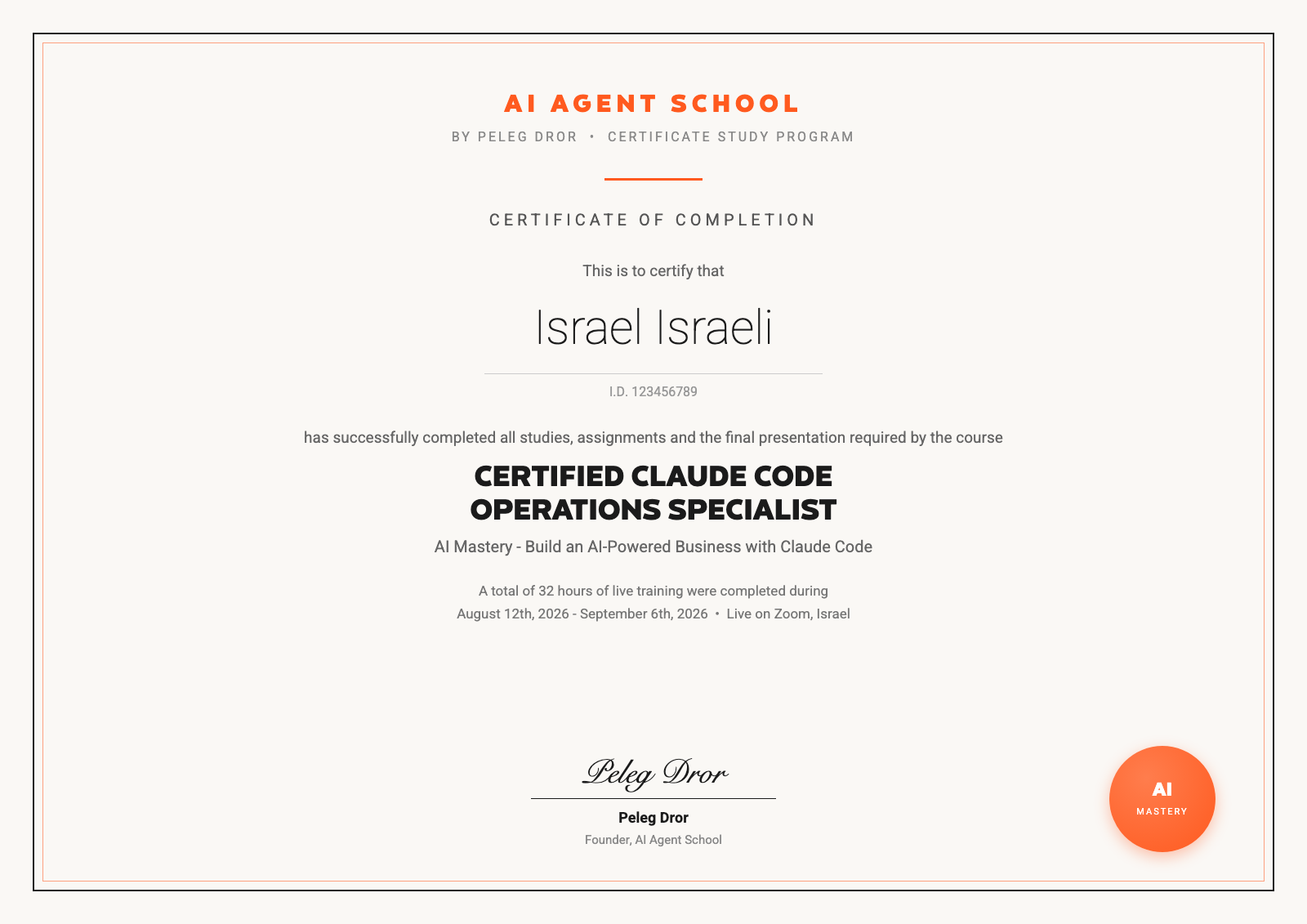
Sample certificate: Certified Claude Code Operations Specialist
Enrollment

Next Cohort: August 2026

8 live Zoom sessions, twice a week, four hours each. The group is kept small so every founder gets personal attention.

Schedule & Dates

  • Starts Wednesday, August 12, 2026 - ends Sunday, September 6, 2026
  • Wednesdays & Sundays, 18:00-22:00 (Israel time)
  • 8 sessions x 4 hours = 32 hours of live training
  • 100% live on Zoom - link sent before every session
S1 · Wed 12/8 S2 · Sun 16/8 S3 · Wed 19/8 S4 · Sun 23/8 S5 · Wed 26/8 S6 · Sun 30/8 S7 · Wed 2/9 S8 · Sun 6/9

Tuition & What's Included

₪10,000
including VAT
  • All 8 live sessions and hands-on labs
  • Course materials, templates and checklists
  • 1-on-1 business lab review with the instructor
  • "Certified Claude Code Operations Specialist" certificate
  • Official tax invoice issued on payment
  • Short intake call before enrollment to confirm the course fits your business
Save My Seat

Enroll Now

Leave your details and I'll get back to you within one business day with enrollment and payment details.

Got it! Your seat request for the August cohort is in - I'll get back to you shortly with the next steps.

Employer & Education-Assistance Friendly

Paying through a workplace education allowance or tuition reimbursement program? You'll get every document HR asks for: enrollment confirmation letter, full syllabus (PDF), official tax invoice and payment receipt, attendance record, and a completion certificate at the end of the program.

Questions or company enrollment: hello@pelegdror.com or the contact form.

Provider: AI Agent School by Peleg Dror. Cohort opening is subject to a minimum number of registrants. Cancellations per the site's Terms of Use and Israeli consumer-protection law. Reasonable changes to the program may occur; participants are notified of any change.

Your Instructor

Taught by Peleg Dror

Peleg Dror
Peleg Dror
AI Educator | Founder of AI Agent School

Peleg has taught more than 3,000 students to build apps, AI agents and automations with Claude Code - without a technical background. He publishes 65+ free Hebrew guides on this site, runs a Claude Code community and courses under the AI Agent School brand, and builds production AI systems for Israeli businesses every day. Everything taught in this course is something he actually runs in production.

Ready to Found Your AI Company?

The August cohort starts Wednesday, August 12, 2026 and seats are limited. Leave your details and I'll get back to you with enrollment and payment details.

I Want In

Or write directly: hello@pelegdror.com